
- July 18, 2026
- admin
- 0
SEO vs GEO: What's the Difference?
Search behavior has changed dramatically over the last few years.
Earlier, users searched on Google, browsed multiple websites, and chose the best answer. Today, many people ask questions directly to ChatGPT, Google AI Overviews, Gemini, or Perplexity and receive instant answers without opening several web pages.
This shift has introduced a new concept called Generative Engine Optimization (GEO).
Many business owners now wonder, “Is SEO still relevant?” or “Will GEO replace SEO?”
The answer is simple: No.
SEO and GEO work together. While SEO helps your website rank in traditional search engines, GEO improves the chances of your content being referenced by AI-powered search platforms.
In this guide, we’ll explain the difference between SEO and GEO, why both are important, and how businesses can prepare for the future of search.
What is the difference between SEO and GEO?
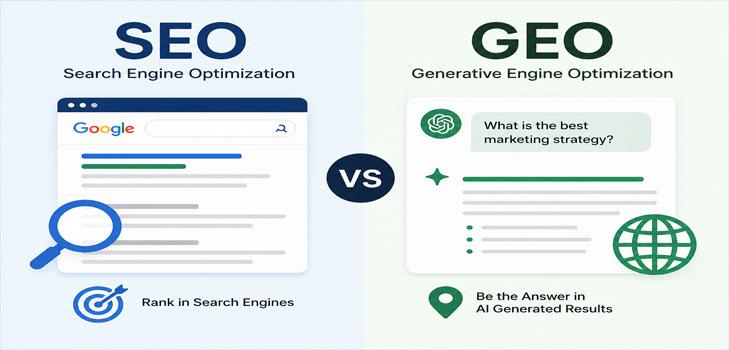
SEO (Search Engine Optimization) focuses on improving a website’s visibility in traditional search engines like Google and Bing. GEO (Generative Engine Optimization) focuses on optimizing content so AI-powered platforms like ChatGPT, Google AI Overviews, Gemini, and Perplexity can understand, trust, and reference it in their responses. The best digital strategy today combines both SEO and GEO.
What is SEO?
SEO (Search Engine Optimization) is the practice of improving your website so it ranks higher on search engine results pages (SERPs).
The primary goal of SEO is to attract organic traffic by making your content relevant, technically sound, and valuable to users.
A successful SEO strategy includes:
- Keyword research
- High-quality content
- On-page optimization
- Technical SEO
- Mobile-friendly design
- Fast page speed
- Internal linking
- Backlink building
Even with AI becoming more popular, SEO remains the foundation of digital marketing because search engines still rely on well-optimized websites to deliver reliable results.


What is GEO?
GEO stands for Generative Engine Optimization.
Instead of optimizing only for Google’s search results, GEO helps your content become understandable and trustworthy for AI-powered search engines.
These include:
- ChatGPT
- Google AI Overviews
- Google Gemini
- Microsoft Copilot
- Perplexity AI
Unlike traditional search engines that display a list of links, AI platforms generate direct answers by combining information from multiple trusted sources.
This means businesses should create content that is accurate, structured, easy to understand, and genuinely helpful.
SEO vs GEO: Key Differences
Although both strategies aim to improve online visibility, they work differently.
| SEO | GEO |
|---|---|
| Optimizes for search engines | Optimizes for AI-generated answers |
| Focuses on keywords and rankings | Focuses on context and content quality |
| Drives organic website traffic | Increases AI mentions and visibility |
| Success measured by rankings and clicks | Success measured by AI citations and references |
| Backlinks remain an important ranking factor | Authority and trust signals become even more important |
Rather than choosing one over the other, businesses should integrate both into their content strategy.
Why GEO Matters in 2026
AI-powered search is becoming a normal part of how people discover information.
Instead of clicking ten different websites, users increasingly expect quick, conversational answers.
Google AI Overviews now summarize search results for many informational queries, while ChatGPT and other AI assistants help users research products, compare services, and solve problems.
For businesses, this means your content must be written not only for search engines but also for AI systems that evaluate clarity, authority, and usefulness.
Companies that adopt GEO early can improve their chances of being featured in AI-generated responses while maintaining strong search rankings.
Is GEO Replacing SEO?
No.
SEO is not disappearing—it is evolving.
Without proper SEO, your website may struggle to get indexed, load efficiently, or earn authority. These signals also influence how AI platforms evaluate trustworthy content.
Think of it this way:
- SEO helps people discover your website through search results.
- GEO helps AI platforms recommend your content during conversations.
A modern digital marketing strategy should combine both approaches instead of treating them as competitors.
How to Optimize Your Website for Both SEO and GEO
The good news is that many best practices benefit both search engines and AI platforms.
Create Helpful Content
Focus on answering real user questions instead of writing solely for keywords.
Use Clear Headings
Well-structured content makes it easier for both users and AI systems to understand your information.
Answer Questions Directly
Start each important section with a concise answer before adding supporting details.
Demonstrate Expertise
Include practical examples, industry insights, and first-hand knowledge wherever possible. This strengthens your E-E-A-T (Experience, Expertise, Authoritativeness, and Trustworthiness).
Add FAQs
Frequently Asked Questions help users quickly find answers while increasing your chances of appearing in Featured Snippets and AI-generated responses.
Build Website Authority
Publish consistently, earn quality backlinks, and keep your content updated. Trust remains one of the strongest signals for both SEO and GEO.
Which Strategy Should Your Business Choose?
The answer isn’t SEO or GEO.
It’s SEO and GEO together.
SEO continues to bring qualified visitors from Google Search, while GEO prepares your business for the growing influence of AI-powered search experiences.
Businesses that invest in both strategies today will be better positioned to reach customers across traditional search engines and modern AI assistants.
Final Thoughts
Digital marketing is entering a new phase where search engines and AI work side by side.
SEO still drives valuable organic traffic, while GEO ensures your content remains discoverable as users increasingly rely on AI-generated answers.
Instead of replacing SEO, GEO builds on its foundation by emphasizing trustworthy, well-structured, and user-focused content.
If your business wants to remain competitive in 2026 and beyond, creating content that satisfies both search engines and AI platforms is no longer optional—it’s a smart long-term strategy.
Frequently Asked Questions (FAQ)
GEO (Generative Engine Optimization) is the process of optimizing website content so AI-powered platforms such as ChatGPT, Google AI Overviews, Gemini, and Perplexity can understand, trust, and reference it in their responses.
SEO improves visibility in traditional search engines, while GEO focuses on improving visibility in AI-generated answers.
Yes. SEO remains essential for improving website rankings, driving organic traffic, and building authority. GEO complements SEO rather than replacing it.
Absolutely. Small businesses that publish clear, trustworthy, and helpful content have a better chance of being referenced by AI search platforms.
Create high-quality content, organize it with clear headings, answer user questions directly, demonstrate expertise, use internal links, implement schema markup, and update your content regularly.
Ready to Grow Your Business with Future-Ready SEO?
Whether you want to rank higher on Google or increase your visibility in AI-powered search platforms like ChatGPT and Google AI Overviews, having the right strategy is essential.
Saturn Web Media helps businesses build a strong online presence with SEO, content marketing, website development, and digital marketing solutions designed for today’s search landscape.
Contact Saturn Web Media today to create an SEO + GEO strategy that drives more traffic, improves online visibility, and prepares your business for the future of AI-powered search.